Views: 0 Author: Site Editor Publish Time: 2026-05-20 Origin: Site
You create heat-resistant steel castings by selecting advanced alloys, applying precise manufacturing steps, and ensuring strict quality control. Jiangsu Guojin Metal New Material Technology Co., Ltd. uses high-temperature alloys and expert processes to produce heat-resistant steel castings for demanding environments. You rely on steel castings with heat-resistant properties for furnace anchoring and industrial profiles. High-temperature performance depends on the right materials and meticulous production. Specialized heat-resistant anchoring solutions and stainless steel profiles help you achieve reliable results in high-temperature settings. You trust high-performance steel castings for durability and strength.
Heat-resistant steel castings maintain their strength and shape in extreme temperatures, making them essential for high-temperature applications.
Choosing the right alloying elements, like chromium and nickel, is crucial for achieving the desired mechanical properties in steel castings.
Proper heat treatment processes enhance the durability and oxidation resistance of steel castings, ensuring they last longer in demanding environments.
Strict quality control through various testing methods guarantees that heat-resistant steel castings meet industry standards for strength and reliability.
Using specialized heat-resistant steel solutions in industries like petrochemical and power generation improves operational efficiency and safety.
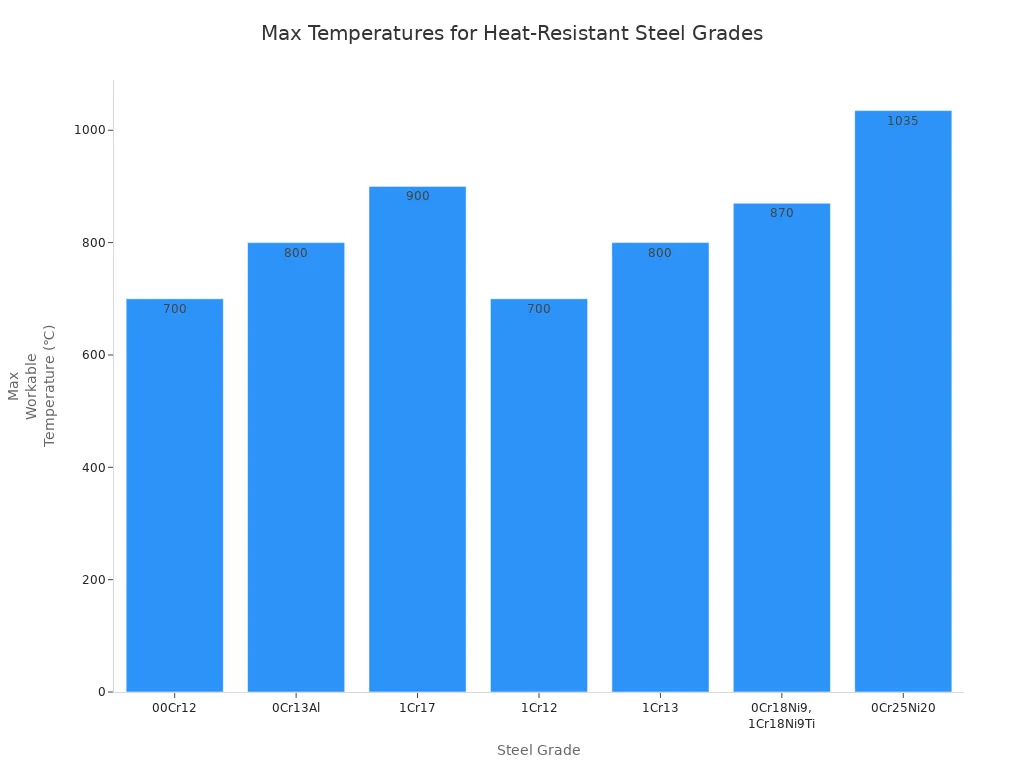
You rely on heat-resistant steel castings when you need materials that can handle extreme conditions. These steel castings show high-temperature strength, which means they keep their shape and do not break down when exposed to heat. Heat-resistant steel castings also offer excellent oxidation resistance. This property helps the steel fight off damage from oxygen at high temperatures. You will notice that heat-resistant steel castings can work in environments above 500°C, and some grades can even handle temperatures over 650°C. The table below shows the temperature ranges for different types of heat-resistant steel:
Steel Grade | Workable Temperature and Applications |
|---|---|
00Cr12 | 600~700℃, used as high temperature, high pressure valve body, burner |
0Cr13Al | 700~800℃, gas turbine compressor blade |
1Cr17 | Below 900℃, used as high temperature parts and nozzles for furnaces |
1Cr12 | 600~700℃, used for high temperature parts of steam turbine blades, nozzles, and boiler burner valves |
1Cr13 | 700~800℃, similar applications as 1Cr12 steel |
0Cr18Ni9, 1Cr18Ni9Ti | Below 870℃, used for boiler heating surface pipe, heating furnace parts, heat exchanger, muffle furnace, converter, nozzle |
0Cr25Ni20 | Up to 1035℃, used for heating furnace parts; gas transmission system parts with working temperature below 950℃ |
You benefit from heat-resistant steel because it resists oxidation, corrosion, and keeps its structural stability. The high-temperature oxidation and corrosion resistance make these steel castings last longer in harsh environments. You can trust them for high-temperature strength and durability.
You see heat-resistant steel castings in many industries that need high-temperature performance. These steel castings play a key role in power generation, petrochemical processing, and manufacturing. You use them for furnace anchoring, steam turbines, and high-temperature machinery. Jiangsu Guojin Metal New Material Technology Co., Ltd. provides you with anchoring solutions and stainless steel profiles for these uses. Here are some common industries and their applications:
Power plants use heat-resistant steel for boilers and turbines.
Mineral pyro processing plants need steel castings for cement and lime kilns.
Waste incineration facilities rely on high-temperature strength and oxidation resistance.
Steel and non-ferrous mills use heat-resistant steel castings for furnace parts.
Metal processing plants need steel castings for heat treating.
Glass making and forming industries depend on high-temperature oxidation resistance.
You choose heat-resistant steel castings when you need high-temperature strength and structural stability. These steel castings give you the oxidation resistance and durability you need for demanding jobs.
Image Source: unsplash
You start the journey of making heat-resistant steel castings by choosing the right raw materials. The chemical composition of these materials is very important. It decides if the steel castings will have the high-temperature strength and mechanical properties you need. You often use heat-resistant alloy steel with elements like chromium, nickel, molybdenum, and tungsten. These alloying elements help the steel resist heat and keep its shape under stress.
Here is a table that shows the main alloying elements and their effects:
Type of Heat-Resistant Steel | Main Alloying Elements | Typical Applications | Heat Treatment Process |
|---|---|---|---|
Pearlitic | Chromium, Molybdenum | Boiler pipes, turbine parts | Normalizing or quenching and tempering |
Martensitic | 7-13% Chromium | Steam turbine blades, fasteners | Normalizing + tempering |
Ferritic | Chromium, Aluminum, Silicon | Low-load parts needing oxidation resistance | Annealing |
Austenitic | Nickel, Manganese, Nitrogen | High-temperature applications | High-temperature solution treatment and aging |
You see that each type of heat-resistant steel uses different elements. These elements change how the steel reacts to heat treatment and how it performs in high-temperature environments. The right mix gives you the heat-resistant and high-temperature strength you need for your steel castings.
The chemical composition of raw materials affects strength and ductility.
Different grades respond differently to heat treatment, which changes mechanical properties.
Carbon and alloying elements decide how the steel behaves under thermal cycling.
You melt the raw materials in special furnaces to make heat-resistant steel castings. The type of furnace you use can change the quality and efficiency of the process. You often choose between fuel-fired furnaces and electric furnaces. Electric arc and induction furnaces are popular because they give you precise control over temperature and composition. This control is important for making sure your steel castings have the right high-temperature strength and heat-resistant properties.
Type of Furnace | Description | Efficiency Notes |
|---|---|---|
Fuel-fired Furnaces | Uses coal, oil, or gas. Each fuel has its own benefits. | Varies by fuel |
Electric Furnaces | Includes resistance, arc, and induction types. Offers precise control. | Generally high |
You monitor the melting process closely. You make sure the alloying elements mix well and the temperature stays steady. This step helps you get the heat-resistant alloy steel you need for strong, reliable steel castings.
You shape the molten steel using molds. The choice of molding method affects the final quality of your heat-resistant steel castings. Sand casting is the most common method for heat-resistant steel because it works well for large parts and is cost-effective. Die casting is less common for steel because it is expensive and better for non-ferrous metals.
Molding Method | Advantages | Disadvantages | Suitability for Heat-Resistant Steel Components |
|---|---|---|---|
Sand Casting | Versatile, cost-effective, good for large parts | Rough surface, lower accuracy, needs more finishing | Best for large, heat-resistant steel castings |
Die Casting | High precision, smooth finish, fast for large volumes | High tooling cost, not ideal for steel, mostly for non-ferrous | Not suitable for most heat-resistant steel castings |
You also pay attention to the mold material. Using ceramic shell molds in investment casting gives you a smoother surface and better dimensional accuracy. This is important when you need precise seal interfaces or good heat transfer. Careful layering and pouring help you avoid defects like porosity and shrinkage.
You pour the molten heat-resistant steel into the mold. You must control several parameters to get the right grain structure and high-temperature strength. Pouring temperature, shell temperature, and cooling rate all play a role.
Parameter | Effect on Grain Structure |
|---|---|
Pouring Temperature | Low shell temperatures have little effect; high temperatures can change grain shape. |
Shell Temperature | Low shell temperatures make fine grains; high shell temperatures make coarser grains in some areas. |
Cooling Rate | Fast cooling makes uniform, fine grains, especially in thin sections. |
You also watch for defects. High shell and pour temperatures can reduce filling defects but may cause coarser grains. Lower temperatures help with uniform grain structure but can make it harder to fill thin parts. A higher cooling rate gives you a more even grain structure, which helps your steel castings perform better at high temperatures.
You let the steel castings cool at a controlled rate. The cooling rate changes the microstructure inside the steel. For example, a cooling rate of 0.08°C/s gives you martensitic microstructures, which are strong and heat-resistant. Slower rates can create bainite or granular structures.
Cooling Rate (°C/s) | Microstructure Type |
|---|---|
0.08 | Fully martensitic |
0.02, 0.08 | Mix of bainite and martensite |
0.01 | Granular bainite with carbides |
After cooling, you perform the shakeout or knockout process. You separate the steel castings from the mold. You must not rush this step. Skipping or hurrying any part of the casting process can cause quality problems. Each step connects to the next, so careful work here helps you get heat-resistant steel castings with the right high-temperature strength and mechanical properties.
You clean the steel castings to remove any leftover sand, shell, or scale. You can use several methods:
Cleaning Method | Working Principle | Features and Suitability |
|---|---|---|
Mechanical Shelling | Uses vibration to break off shells. | Fast, but noisy and dusty. Not good for complex shapes. |
Electrohydraulic Sand Cleaning | Uses shock waves in water to remove sand and cores. | Efficient, low cost, no dust. Needs safety steps. Good for simple sand molds. |
High-pressure Hydraulic Cleaning | Uses water jets to break and remove shells. | Safe, dust-free, can polish surfaces. |
Shot Blasting | Sprays iron shots to clean surfaces. | Good for many shapes. Can lower accuracy and roughness. Used for simple investment castings. |
Sand Blasting | Uses sand and air or water to remove sand and scale. | Works for many shapes. Keeps accuracy and roughness. Needs dust removal equipment. |
You also prepare the surface to improve corrosion resistance and longevity. If you leave porosity or unmelted material, corrosive agents can get in and damage the steel. Preheating the steel before coating helps the coating stick better and lowers porosity. A rougher surface can help the coating bond, which protects your heat-resistant steel castings from corrosion and extends their life.
Tip: Careful cleaning and surface preparation help your steel castings last longer in high-temperature and corrosive environments.
By following each step with care, you make sure your heat-resistant steel castings have the high-temperature strength, mechanical properties, and durability you need for demanding jobs. The right casting process, from raw materials to surface prep, gives you reliable results every time.
Image Source: pexels
You improve the performance of heat-resistant steel castings by using heat treatment. Heat treatment changes the internal microstructure and gives you better mechanical properties. You use several heat treatment processes to make steel castings stronger and more reliable in high-temperature environments.
Annealing softens steel, relieves internal stresses, and refines its structure. You heat the steel above its critical temperature and cool it slowly.
Normalizing refines grain size and makes the structure more uniform. You heat the steel above the upper critical temperature and let it cool in still air.
Hardening, also called quenching, maximizes hardness. You heat the steel to form austenite and cool it quickly to create martensite.
Tempering reduces brittleness and increases toughness. You reheat the quenched steel to a lower temperature.
Case hardening creates a hard surface over a softer core. You add carbon or nitrogen to the surface.
You see how quenching and tempering cycles affect mechanical properties in the table below:
Intercritical Temperature | Tensile Strength (MPa) | Elongation (%) | Observations |
|---|---|---|---|
770 °C | 1214 | 12.4 | Enhanced ductility with moderate strength decrease |
820 °C | 1307 | 10.7 | Higher strength but lower ductility |
You use single quenching and tempering to get ferrite-bainite or ferrite-martensite microstructures. This improves toughness and reduces strength. Austempering at lower temperatures gives you bainite-martensite, which increases hardness and impact strength. Double quenching and tempering refines the grain and increases yield strength. You achieve structural stability and better oxidation resistance with these methods.
Tip: Proper heat treatment helps you fight oxidation and corrosion, making your heat-resistant steel castings last longer.
You ensure quality by using strict inspection and testing methods. You check heat-resistant steel castings for strength, durability, and oxidation resistance. You use several tests to confirm that your castings meet industry standards.
Testing Method | Description |
|---|---|
Chemical Composition Testing | Ensures the correct balance of elements like carbon, manganese, and silicon in the steel. |
Mechanical Property Testing | Includes tensile, hardness, and impact testing to assess the steel's strength and durability. |
Surface Testing | Detects surface defects such as cracks, pits, and oxidation. |
Non-destructive Testing (NDT) | Methods like ultrasonic and radiographic testing inspect integrity without damaging the steel. |
You use impact testing to see how steel behaves under sudden loads. Wear resistance tests simulate real service conditions. Corrosion tests show how steel reacts to environmental factors. Creep tests measure deformation at high temperatures. Radiography finds internal defects. Magnetic particle testing detects surface and near-surface discontinuities. Ultrasonic testing uses sound waves to find hidden flaws.
You trust these methods to confirm that your heat-resistant steel castings have the right mechanical properties, oxidation resistance, and corrosion protection. Careful inspection ensures your castings perform well in demanding environments.
You depend on heat-resistant steel for furnace anchoring systems in high-temperature environments. These solutions keep your industrial furnaces safe and stable. You use Y Type and V Type anchors to hold the lining in place inside a boiler or kiln. Each anchor type serves a special purpose.
Anchor Type | Description | Application | Benefits |
|---|---|---|---|
V Type | Standard for general repairs, suitable for single-layer linings 3-10 inches thick. | Ideal for standard jobs on boilers or kilns. | Holds lining securely while allowing for slight expansion during heating. |
Y Type | Heavy-duty alternative for thicker or multi-layer walls. | Recommended for linings thicker than 10 inches or requiring extra strength. | Anchors concrete further from the steel shell, critical for soft insulation layers. |
You choose these anchors because they give you:
Stability and integrity, even under extreme heat
Thermal stability, so the anchors keep their shape during temperature changes
Resistance to oxidation and corrosion, which protects your furnace from damage
Enhanced durability and longevity, so you replace parts less often
Cost-effectiveness, which saves you money over time
You see how heat-resistant steel anchors help your furnace run safely and efficiently.
You use heat-resistant steel castings in petrochemical plants and steel mills for many reasons. These castings work well in high-temperature settings like industrial ovens, heat-treating furnaces, and other load-bearing equipment. You find them in trays, baskets, furnace rolls, rails, walking beams, chain guides, nozzles, and heater elements.
You rely on these castings because they provide:
High-temperature mechanical stability for steam turbine blades and other heat-resistant parts
Oxidation and corrosion resistance, which keeps your equipment safe
Dimensional stability under thermal cycling, so your steam turbine blade stays in shape
Suitable surface finish and tolerances for precise jobs
You also benefit from tailored solutions. Chemical handling equipment, corrosion-resistant piping, and filtration systems help you handle chemicals safely. Industrial-grade tanks and containment systems give you reliable storage. These specialized products help you meet safety standards, reduce risks, and optimize your processes.
Note: You improve operational efficiency and safety when you use the right heat-resistant steel solutions in your plant.
You use stainless steel profiles, such as rods and angles, in high-temperature industrial settings. These profiles give you a high strength-to-weight ratio, which means you get strong support without extra weight. You need this for load-bearing structures in a boiler or heat exchanger.
Stainless steel profiles also offer:
Superior corrosion resistance, so they last longer in harsh environments
Long lifespan and low maintenance, which reduces downtime and repair costs
Versatility in design, so you can cut, weld, bend, or shape them for your needs
You use these profiles in steam turbine parts, heat exchanger frames, and other critical equipment. You trust stainless steel profiles to keep your operations running smoothly, even when facing oxidation and high temperatures.
You follow each step in making steel castings to get the best results. You select advanced materials, use careful heat treatment, and check quality at every stage. The table below shows how precision methods improve steel castings:
Property | Precision Method | Traditional Method |
|---|---|---|
Yield Strength (MPa) | 314 | 271 |
Hardness (HV) | 420 | 366 |
You see that heat treatment gives steel castings better strength and longer life. When you choose Jiangsu Guojin, you get steel castings with top heat treatment, high durability, and strong performance in tough jobs.
You get heat-resistant steel castings with special alloying elements like chromium and nickel. These elements help your castings keep strength and shape at high temperatures. Regular steel castings cannot handle extreme heat as well.
You look at the furnace type, wall thickness, and temperature. For thick or multi-layer linings, you pick Y Type anchors. For standard jobs, you use V Type anchors. Always match the anchor to your furnace needs.
You use heat treatment to change the steel’s structure. This process makes your castings stronger and more durable. Proper heat treatment also improves resistance to oxidation and wear.
You use tests like ultrasonic inspection, hardness testing, and chemical analysis. These tests help you find defects and confirm the steel meets your standards.
Tip: Always ask your supplier for test reports to ensure you get reliable products.