Views: 0 Author: Site Editor Publish Time: 2026-06-05 Origin: Site
Unplanned furnace downtime remains a massive headache for industrial plant operators worldwide. This operational paralysis often stems directly from refractory lining failure rather than simple steel shell degradation.
The structural integrity of this massive refractory lining depends entirely on the hidden anchoring system. Stainless steel serves as the industry default. However, relying on generic grades under extreme thermal cycling is a serious mistake. Corrosive atmospheres exacerbate the damage. This reliance inevitably leads to premature oxidation, severe creep, and catastrophic internal collapse.
We will explore the precise thermal limits of different alloys in demanding environments. You will learn how to match mechanical shapes to your specific stress factors. Ultimately, this article provides plant engineers and procurement teams with an evidence-based framework. You can use it to specify and implement a highly reliable furnace anchor system based on exact thermal, chemical, and mechanical realities.
Standard stainless steel (like 304) degrades rapidly above 850°C; continuous high-temp operations require specialized grades like 309, 310, or nickel-based alloys.
Shape selection (V-type vs. Y-type) must be dictated by the lining thickness, vibration levels, and thermal expansion differentials, not just unit cost.
High-temperature strength requires High-Carbon (H) grades; Low-Carbon (L) grades should be strictly avoided in high-stress thermal applications.
Omitting expansion caps during installation is a guaranteed failure point, as metal expands faster than refractory brick, causing internal lining fractures.
Many operators severely misjudge the maximum operating temperatures of standard metals. Most 300-series stainless steels will glow visibly red at 850°C. They certainly will not melt at this thermal threshold. However, continuous long-term exposure triggers severe discoloration. You will also see a massive loss of tensile strength. Structural degradation becomes an inevitable reality over time.
Designing a reliable heat resistant anchor requires strict attention to advanced metallurgy. Industry standards demand casting grades like 309 and 310 for low-stress load environments. Furnace roofs serve as prime examples here. Engineers must evaluate carbon content carefully. You must specify High-Carbon (H-grade) variants. These specific alloys deliver superior creep resistance under pressure. We strongly advise you to reject Low-Carbon (L-grade) variants outright. These materials lack vital high-temperature mechanical strength. They will easily warp under sustained heat loads.
Procurement teams often upgrade to 316 stainless steel. They assume a premium grade guarantees better baseline performance. This assumption creates a fatal engineering trap. You must avoid using 316 or 317 stainless steel in stagnant, extremely high-temperature airflow environments. The molybdenum content inside these specific alloys becomes a major liability. The metal traps it as a localized oxide. This internal reaction leads to rapid catastrophic oxidation. The structure literally consumes itself from within.
Evaluating your exact chemical and thermal environment remains the most critical engineering step. Different zones inside a single plant demand completely different metallurgical approaches.
You can comfortably use 304 Stainless Steel for basic requirements. It provides adequate mechanical strength for medium-temperature applications. It carries minimal oxidation risks in clean, well-ventilated operational spaces. You should only use it where thermal cycling remains relatively calm.
We consider 310 Stainless Steel the absolute workhorse for high-temp industrial ovens and kilns. It offers excellent dimensional stability across broad temperature ranges. This low thermal expansion prevents sudden cracking. It delivers robust oxidation resistance due to much higher Chromium and Nickel content.
Standard alloys degrade quickly when aggressive sulfur enters the atmosphere. You must pivot to 253MA in these situations. Metallurgists specifically engineered 253MA for environments prone to aggressive sulfidation. It handles severe heating and cooling cycles beautifully. It prevents early-stage metal fatigue effectively.
You face tremendous challenges when combining extreme heat and high corrosion. Petrochemical exhaust lines demonstrate this perfect storm perfectly. Standard stainless oxide layers fail completely here. Your evaluation must shift toward specialized superalloys like Inconel 601 or Hastelloy. Engineers often consider advanced ceramic or SiC coatings. These protective layers actively prevent deep grain boundary corrosion.
Alloy Grade | Max Temperature Limit | Core Environmental Strength | Best Application Scenario |
|---|---|---|---|
304 Stainless Steel | 1650°F / 900°C | Adequate tensile baseline strength | Medium-temperature, low oxidation |
310 Stainless Steel | 2100°F / 1150°C | Excellent dimensional stability | Standard industrial ovens and kilns |
253MA | 2150°F / 1175°C | High sulfidation resistance | Cyclic heating, high-sulfur gases |
Inconel 601 | 2200°F+ / 1200°C+ | Extreme grain boundary defense | Petrochemical exhaust, severe corrosion |
Shape dictates survival just as much as basic metallurgy. A poorly chosen physical profile will tear a highly robust castable lining apart. You must align the geometry with your mechanical stress profiles.
The V-Type profile features a simple angled design. This angle creates a powerful "wedging" effect against castables. We consider this best suited for relatively thin refractory linings. Standard kilns and industrial incinerators rely heavily on them. They provide maximum holding power in straightforward, low-vibration environments.
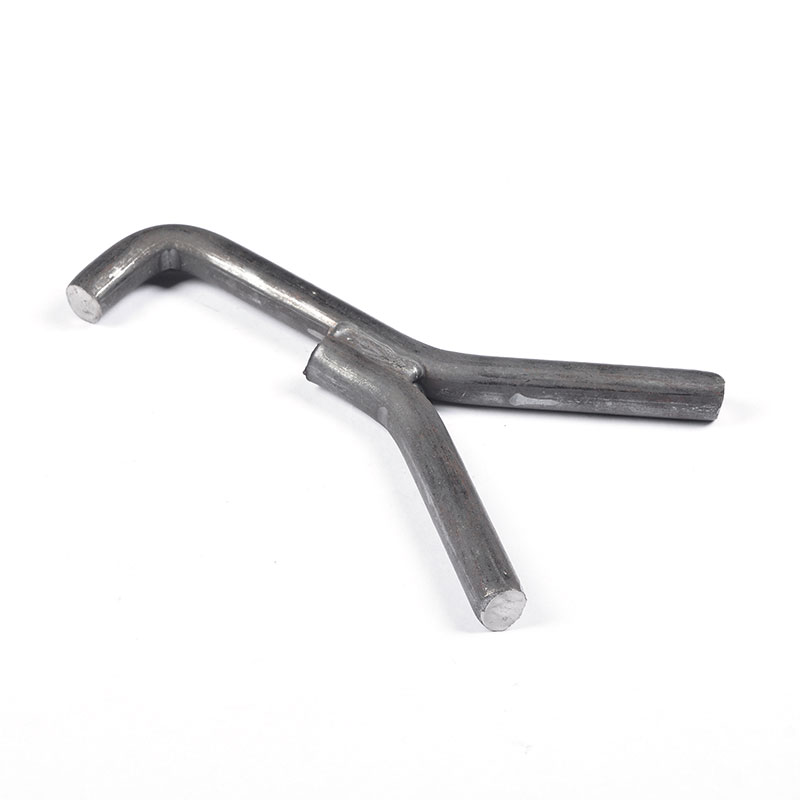
The split-arm design defines the kiln stainless steel anchorage standard for heavy stress. It provides a much wider support surface across the lining body. This makes it the superior choice for managing thermal expansion and contraction. We highly recommend it for high-fluctuation environments. It performs flawlessly on suspended roofs where gravity constantly pulls downward.
These advanced designs feature wavy legs to maximize friction and structural grip. This geometry actively diffuses concentrated mechanical stress. This is the mandatory specification for extremely turbulent environments. Equipment subjected to mechanical shock, intense vibration, or severe thermal cycling demands them. Chemical reactors represent a prime use case.
V-Type: Perfect for thin linings requiring simple wedging forces.
Y-Type: Essential for broad surface support and heavy thermal expansion.
Corrugated: Mandatory for environments experiencing extreme mechanical vibration.
Selecting the perfect alloy and shape means nothing if you install them incorrectly. Mechanical failure usually traces back to subtle implementation errors. You must enforce strict engineering rules during assembly.
Metals behave very differently than rigid ceramics under intense heat. Metal anchors expand at a significantly faster rate than the surrounding refractory concrete or brick. The rigid brick stubbornly resists this physical growth. If you provide no buffer room, the expanding steel will crush the surrounding ceramic structure.
You must prevent the expanding metal from internally cracking the refractory lining. Plastic expansion caps or sleeves must absolutely be installed on the anchor tips. Operators often skip this step to save time. This omission is a guaranteed failure point. These simple plastic caps melt away rapidly during initial heat-up. Their disappearance leaves a perfectly sized void. This provides the exact necessary buffer space for the expanding steel tip.
How deep should you embed these high temperature furnace parts? Standard engineering practice dictates a strict depth ratio. The anchor height should cover exactly 60% to 80% of the total refractory lining thickness. Going deeper exposes the metal tip directly to extreme surface temperatures. Going shallower severely compromises your overall holding power.
You cannot simply guess where to place them. Spacing must be mathematically calculated based on exact structural load. Industry baselines dictate specific intervals for guaranteed stability.
Overhead/Roof Installations: Place them tightly at 150-200mm intervals to combat gravity.
Vertical Wall Applications: Expand spacing to 300mm intervals where gravity acts laterally.
High-Stress Zones: Tighten spacing formulas wherever direct burner flames strike.
A flawless engineering design often falls apart during the final procurement phase. You must rigorously audit purchase requests to prevent dangerous material substitutions.
You must closely audit procurement requests to ensure complete material harmony. Mixed-metal anchor systems must be explicitly forbidden in your plant. Mixing different grades in high-heat environments drastically accelerates galvanic corrosion. Electrons flow aggressively between dissimilar metals. This silent electrical reaction destroys the vital weld joints incredibly fast.
Before finalizing any RFP, deeply analyze your exact process gas chemistry. You must document specific Sulfur, Carbon, and Oxygen levels. A high-sulfur environment will literally turn baseline stainless steel into a soft paste. We call this destructive process sulfidation. Identifying high sulfur requires an immediate upgrade to 253MA or Inconel.
Downgrading alloy quality creates massive operational risks. Lowering material grades to reduce raw material weight drastically reduces the overall lifespan of a multi-million-dollar refractory lining. Procurement teams must completely ignore minor structural weight variations. You must evaluate every selection strictly based on Mean Time Between Failures (MTBF). Using robust alloys significantly stretches your operational cycles. This proactive approach ensures maximum plant reliability over decades.
Stainless steel anchors offer remarkable high-temperature resistance when specified correctly. The final verdict demands precise alignment between metallurgy and operational realities. You must match the specific alloy grade, carbon content, and mechanical shape perfectly to the thermal and chemical limits of your furnace.
Engineers should immediately conduct a comprehensive failure analysis of their previous refractory lining. You must actively check for deep sulfidation, surface oxidation, or stress-induced thermal cracking. Never blindly re-order the exact same anchor specification without this critical audit. Finally, always consult with a dedicated metallurgist. They will help you align current operational temperatures with the appropriate H-grade stainless or specialized superalloy.
A: 316 stainless steel contains molybdenum, which in highly stagnant, high-heat environments can form trapped oxides that aggressively accelerate localized corrosion. 309 or 310 grades are usually safer alternatives for continuous high temperatures.
A: Because the steel anchor expands under heat much faster than the refractory material, the lack of an expansion cap forces the expanding metal outward, causing the internal lining to crack and eventually collapse.
A: No. High sulfur content at extreme temperatures causes rapid sulfidation, turning lower-grade stainless steel brittle or mushy. High-sulfur applications require specialized alloys like 253MA or Inconel 601.
A: The industry standard is for the anchor to penetrate 60% to 80% of the total refractory lining thickness to balance holding power with temperature protection.